
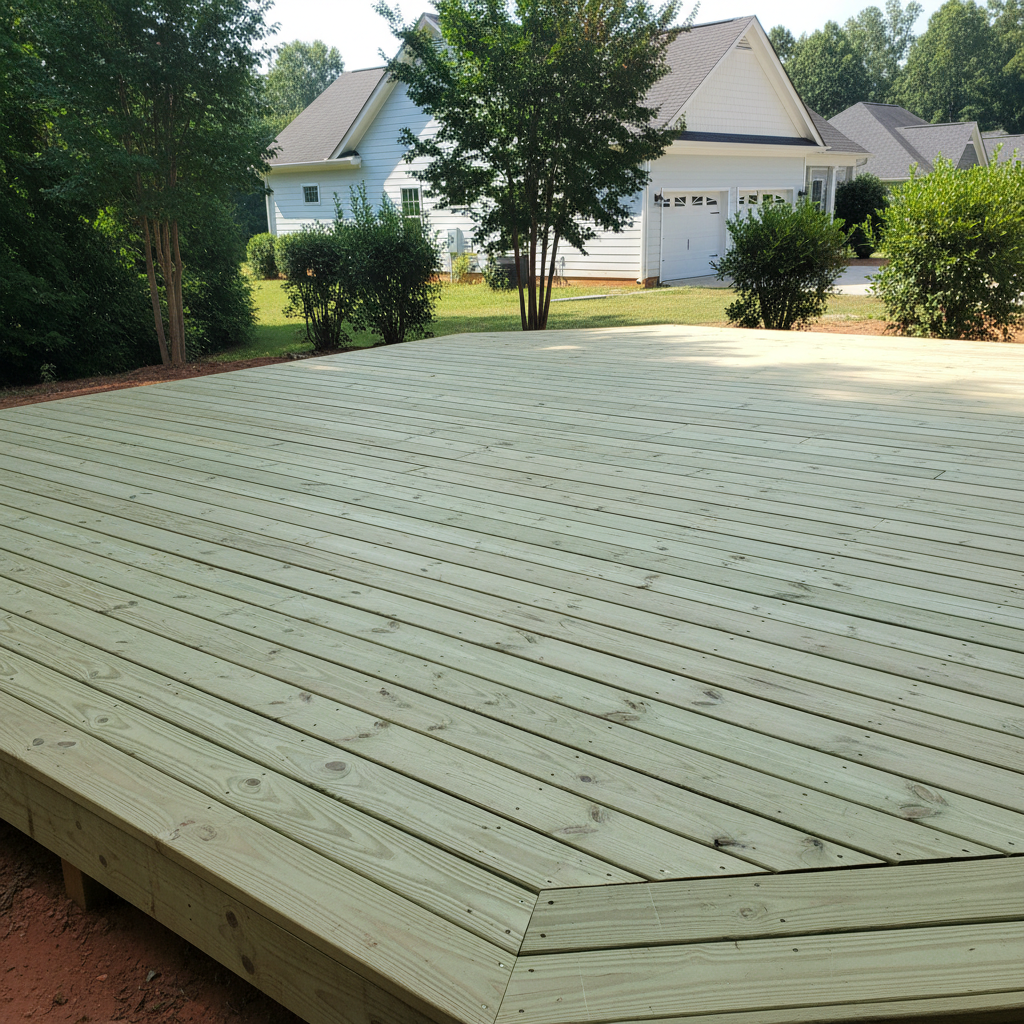
Most people choosing a deck builder are comparing three quotes that look nothing alike and trying to guess why. One guy is $9,000, one is $14,000, one is $22,000. They're not building the same deck, even if the drawing looks the same on paper. The difference is usually buried in the footings, the fasteners, and whether anyone pulled a permit.
Here's what actually separates a deck that lasts 25 years from one that's wobbling by year six.
What Brookhaven's Clay and Weather Do to a Deck
Metro Atlanta sits on Piedmont red clay, and Brookhaven is no exception. This soil holds water like a sponge in a wet spring and then shrinks hard and cracks in a dry August. A footing that isn't poured deep enough, or isn't resting on undisturbed soil below the frost line, will heave over a few seasons as the clay swells and contracts around it. Posts start leaning. Stairs separate from the landing. In this area, footings generally need to go down around 24 to 36 inches depending on the deck's height and load, below where that clay moves the most. A builder who's pouring 12-inch sonotubes and calling it done is setting you up for a problem that won't show up until year three or four, long after the check has cleared.
We don't get brutal winters here, but we do get somewhere around 15 to 20 freeze-thaw cycles most years, not deep freezes, but enough swings through the 30s overnight that water trapped in a crack or a bad joint connection keeps working it wider. Combine that with our humidity, which sits high from May through September, and you've got conditions that are hard on any wood connection that wasn't flashed properly. The ledger board, where the deck bolts into the house, is the single most common failure point in this climate. It needs to be lag-bolted or through-bolted, not nailed, and it needs flashing that sheds water away from the house framing, not into it. If a builder glosses over how they're attaching the ledger, that's the question to push on.
Spring in Brookhaven also brings heavy thunderstorm activity, and in recent years we've seen tropical system remnants dump several inches of rain in a short window. Decks built without proper drainage under the joists, or without gapping composite boards correctly for water runoff, end up with standing water and rot starting from underneath where you can't see it.
Permits and Inspections Here
Brookhaven became its own city in 2012 and runs its own permitting through the city's Community Development department, separate from unincorporated DeKalb County. Most decks attached to a house and more than about 30 inches off the ground need a permit, which typically means a footing inspection before the concrete goes in and a final inspection once it's framed and railed. A builder who tells you permits are optional, or that they'll just handle it and you don't need to see anything, is either unfamiliar with how it works here or hoping you won't ask. Ask for the permit number once it's pulled. It's public record.
If you're in Historic Brookhaven, Ashford Park, or one of the other older HOA neighborhoods, there may also be an architectural review step before you even get to the city, especially if the deck is visible from the street. Newer subdivisions off Peachtree Road and in the areas built out in the last 15 years sometimes have similar covenants. Ask early so it doesn't hold up your project in July when everyone wants to be outside.
What's Already in the Ground on Older Lots
A lot of Brookhaven's housing stock dates to the 1950s and 60s, especially around Ashford Park, Brittany, and Drew Valley, with a good number of teardown rebuilds mixed in on the same streets now. On an older lot, you're more likely to run into old concrete footings from a prior deck, cast iron or clay sewer lines that weren't mapped, and house framing that wasn't built to carry a ledger-mounted structure at all. A builder who's done work in this area knows to check the band joist and sometimes the sill plate before bolting anything to it, and knows to call 811 before digging footings, not after they hit something.
Questions to Ask, and Answers That Should Worry You
- "What size and spacing are the joists?" If they don't know off the top of their head, or just say "standard," that's not an answer. For most residential decking, 16 inches on center is typical, but span and board type change that.
- "Are you using galvanized or stainless fasteners?" Modern pressure-treated lumber is heavy in copper, which corrodes plain steel hardware over time. If they're reaching for whatever's cheap at the hardware store, that connection is a problem waiting to happen.
- "What's your warranty on the structure versus the decking surface?" A fair answer separates the two. Composite boards and framing lumber fail differently and should be covered differently.
- "Can I see your license and insurance?" Not "we're covered," an actual document.
Walk away from anyone who won't put a start date in writing, anyone who wants full payment up front, and anyone who tells you a permit "isn't necessary for a deck this size" without checking. Walk away from a bid that's dramatically lower than the others without an explanation, because the gap is almost always coming out of the footings or the fasteners, the two things you'll never see again once the boards are down.
What a Real Proposal Looks Like
A proposal worth signing lists lumber species and grade, footing depth, joist spacing, fastener type, and whether staining or sealing is included or separate. It should note the number of inspections expected and roughly how many weeks out the permit review runs, since that varies by season, spring being the busiest stretch for both builders and the city's inspectors. If staining is part of the job, it should mention that a new deck needs to weather for a few weeks before the first coat goes on, and that a coating generally needs 48 to 72 hours of dry weather to cure, which matters a lot given how often summer afternoons here turn into a pop-up storm.
None of this guarantees a perfect build. It does mean you're hiring someone who's thinking about what the clay, the rain, and the next ten Augusts are going to do to your deck, not just what it'll look like the day it's finished. That's the kind of detail we build into every job at Westbrook Outdoor Living, and it's worth asking any builder you're considering the same way.